3D Intraoral Digital Scan service image
3D Intraoral Digital Scan

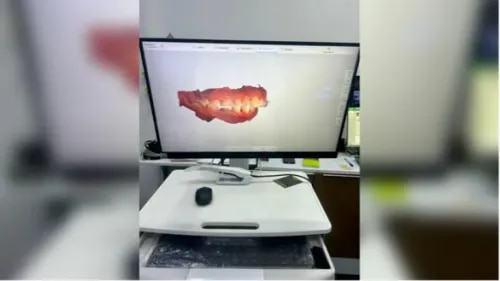
A 3D intraoral digital scan is a modern dental imaging technique that captures a highly accurate, three-dimensional image of a patient’s teeth, gums, and bite using a small handheld device called an intraoral scanner. How It Works Scanning: The dentist or dental assistant moves the scanner around the patient’s mouth. It uses optical or laser technology to capture thousands of images per second. Image Processing: The software instantly stitches these images together to create a 3D digital model of the oral cavity. Visualization: The model can be viewed in real-time on a screen, rotated, zoomed, and analyzed for accuracy. Uses Digital impressions for crowns, bridges, veneers, and aligners Implant planning and surgical guides Orthodontic assessment and aligner fabrication Monitoring oral changes over time (wear, gum recession, etc.) Patient education — helps patients visualize their treatment needs. Advantages No messy impression materials (more comfort for patients) High accuracy and fewer remakes Fast turnaround for labs and digital workflows Better communication between dentist, lab, and patient Digital record keeping and easy comparison over time.

Denture fabrication service image
Denture fabrication

Denture fabrication We are the best dental clinic in Lajpat Nagar and South Delhi, We use a painless injection technique with our latest technology to make the entire dental experience absolutely pain-free and stress-free. We have a special package for the Inbound clients / patients. The process of fabricating a denture usually begins with an initial dental impression of the maxillary and mandibular ridges. Make preliminary impression using a stock tray specifically designed for edentulous patients and alginate. Tray periphery may be enhanced with wax. Fabricate preliminary cast and custom impression tray. This cast should be slightly over-extended in the periphery. Master impression using border molded custom tray with PVS or polyether. (Click this link for a course on impressions for edentulous patients.) Send impression to laboratory for fabrication of master cast and record base/wax rim. Contour wax rimsConfirm fit and extension of record base. Contour wax rims for lip support, future incisal edge position, occlusal plane, occlusal vertical dimension and midline. Record facebow transfer and bite registration at correct vertical dimension. Select tooth mold, tooth shade and desired occlusal scheme. Return all items to laboratory. Lab will index and mount casts and develop trial denture set-up. Try-in initial denture set-up. Depending on clinician/technician preference this may be either an “esthetic try-in” of just the maxillary anterior teeth (requiring an additional try-in) or the full set-up. Evaluate for accuracy of mounting, occlusal vertical dimension, esthetics and phonetics. Perform modifications as necessary. Patient and clinician should be satisfied before moving to next step. Return all items to laboratory for prosthesis fabrication. Dentures should be remounted and equilibrated to compensate for errors in denture processing. Dentures should be returned finished and all external surfaces polished. Many clinicians will request clinical remount casts to be fabricated and returned with the case. Insert and adjust denturesInsert dentures and adjust as necessary. Typical post insertion follow-up includes 24-hour, one-week and one-month appointments. Determine an appropriate recall interval.

Root canal treatments (RCT) service image
Root canal treatments (RCT)

Root canal treatments (RCT) We are the best dental clinic in Lajpat Nagar and South Delhi, We use a painless injection technique with our latest technology to make the entire dental experience absolutely pain-free and stress-free. We have a special package for the Inbound clients / patients. Root Canal Treatment (RCT) also is known as Endodontic Treatment is a procedure done when the tooth decay reaches the pulp (innermost layer of the tooth) causing inflammation. Earlier any significantly infacted or damaged tooth was just extracted. Today due to this root canal treatment most of the damaged or impacted teeth can be saved thus avoiding their extraction. An extraction is truly the last resort Indications for the Root Canal Treatment:- • Severe decay or injury involving the nerve of tooth. • Severe sensitivity to hot and cold foods. • Spontaneous pain or throbbing while biting. • An abscess (Infection or Pus) in the bone. Root Canal treatment consists of:- Removal of the infected nerve tissue that lies within the root of every tooth. This nerve tissue once infected by decay or injury to the tooth causes pain, or severe sensitivity to hot and cold foods. This infected nerves tissue eventually forms as abscess. • The first step in RCT is to obtain access to the nerve tissue which is accomplished by establishing a small access opening on the top of the teeth. All this is done under local anesthesia. • All this infected nerve tissue is removed right up to the entire length of the root after determining the root length. Then the entire root canal is reshaped so as to remove the infected material and accept the special root canal filling material. • The number of sittings for a root canal treatment depend upon the severity of infection and complicity of the procedure. • The final step would be to seal the root canal with a sterile, plastic material called gutta percha. This would prevent possible future infection. • Due to the use of local anesthesia the entire procedure becomes painless. • In order to restore the normal form and function of the tooth and also to prolong its life a crown is recommended to be placed on the root canal treated teeth.

Cleaning and polishing of teeth service image
Cleaning and polishing of teeth

Cleaning and polishing of teeth We are the best dental clinic in Lajpat Nagar and South Delhi, We use a painless injection technique with our latest technology to make the entire dental experience absolutely pain-free and stress-free. We have a special package for the Inbound clients / patients. Tooth polishing is a simple procedure that dentists pair with tooth scaling during your biannual cleaning and exam. Most of the people visiting the dentist have a lot of anticipation regarding the cleaning procedure. They apprehend it to be a painful and uncomfortable process. However, one should know about the entire process before having any such fears. In short, dental cleaning consists of steps to clean around the gum line and remove all the tartar and plaque. Below is the process in detail: Examining the mouth physically: First of all, the dental hygienist checks the mouth with a small mirror. It is to make sure that there are no major dental issues. If some symptom prevails, the hygienist calls the dentist to make them fine to proceed. Remove plaque and tartar: The hygienist now uses a scalar to remove the tartar and plaque around the gum line and in between the teeth. Cleaning with toothpaste: After all the tartar is wiped out, the hygienist will clean the teeth with an electric toothbrush. It is for the deep cleaning of teeth. Flossing and rinsing: To remove the leftover food and debris, you will be given an expert flossing session followed by the liquid Fluoride rinse. Fluoride treatment: The final step of the session is Fluoride treatment. The procedure is provided to maintain dental hygiene for at least 2-3 months

Wisdom tooth removal service image
Wisdom tooth removal

Wisdom tooth removal We are the best dental clinic in Lajpat Nagar and South Delhi, We use a painless injection technique with our latest technology to make the entire dental experience absolutely pain-free and stress-free. We have a special package for the Inbound clients / patients. Wisdom teeth removal surgery is an outpatient procedure that is typically performed by a dentist or oral surgeon. “Wisdom teeth” are a type of molar. Molars are the chewing teeth found furthest in the back of the mouth. Most humans have first, second, and third molars. A person's third molars are their wisdom teeth. These teeth come in behind the 2nd molars (if there is room for them and they are aligned properly), usually during a person's late teens or early twenties. Typically a person will have four wisdom teeth: upper left, upper right, lower left, and lower right. What are “impacted wisdom teeth?” In dental terminology an “impacted” tooth refers to a tooth that has failed to emerge fully into its expected position. This failure to erupt properly might occur because there is not enough room in the person's jaw to accommodate the tooth, or because the angulation of the tooth is improper. Classifications of impacted wisdom teeth. Dentists use specific terms to describe the positioning of impacted wisdom teeth. The most common type of impacted wisdom tooth is one that is impacted mesially. The term “mesial” simply means that the wisdom tooth is angled forward, toward the front of the mouth. The other types of impactions, in order of frequency of occurrence, are the vertical, horizontal, and distal types. In addition to mesially, vertically, horizontally, and distally impacted, wisdom teeth can also be classified as soft tissue or bony impactions. The term “bony” impaction indicates that the wisdom tooth is still fully encased in the jaw's bone. A “soft tissue” impaction is one where the upper portion of a wisdom tooth (the tooth's crown) has penetrated through the bone, but has not yet erupted fully through the gums. Why might a wisdom tooth be impacted? The reason why some wisdom teeth are impacted is not an easy question to answer. A primary cause of wisdom tooth impaction is simply that there is inadequate jawbone space behind the person's second molar. Why this lack of space exists is not fully understood, however there does seem to be a correlation between large tooth size, tooth crowding, and the presence of impacted wisdom teeth. It has been theorized that the coarse nature of stone age man's diet had the effect of producing extensive tooth wear, not only on the chewing surface of the teeth but also on the sides of the teeth where neighboring teeth rest against each other. The net effect of this wear would be a reduction in the collective “length” of the teeth as a set, thus creating enough jawbone space to accommodate the wisdom teeth by the time they erupted. In comparison the diet of modern man does not usually cause a significant amount of this type of tooth wear. It has also been argued that the coarse nature of stone age man's diet, as compared to modern man's relatively soft diet, probably required more activity of the “chewing” muscles. This activity could have stimulated greater jawbone growth, thus providing more space for wisdom teeth. The harsh and threatening world of the caveman no doubt often lead to the occurrence of broken teeth and even tooth loss. Once a tooth (or a portion of it) is missing the teeth behind it have a tendency to move forward. This shifting would make more jawbone space available for the wisdom teeth. In comparison, with the advent of modern dentistry there are relatively few reasons why a tooth should be lost or remain in a state of disrepair. Why do impacted wisdom teeth need to be extracted? The precise reasons why an individual's wisdom teeth might need to be extracted should be explained to them by their dentist, after an examination which almost certainly will need to include dental x-rays. While each person's situation will be unique, some of the more common topics dentists discuss when they describe to a person why their wisdom teeth should be removed are listed below. The rationale associated with the first group of reasons given here is based on the fact that wisdom teeth, either partially or fully erupted, are often very difficult to clean. (The term “erupted” used here means that the wisdom tooth has, at least to some degree, penetrated through the gums.) Any location in the mouth where plaque is allowed to accumulate and persist, such as around a partially erupted wisdom tooth, a person will run the risk of developing dental problems such as tooth decay (“cavities”), periodontal disease (“gum disease”), or recurring infections. Typically it is the partially erupted impacted wisdom tooth that is more unpredictable or troublesome for a person than an impacted wisdom tooth that has never penetrated through the gum tissue.

Bone Grafting service image
Bone Grafting

Bone Grafting We are the best dental clinic in Lajpat Nagar and South Delhi, We use a painless injection technique with our latest technology to make the entire dental experience absolutely pain-free and stress-free. We have a special package for the Inbound clients / patients. In the past, the treatment of periodontal (gum) disease was considered to be painful and disfiguring. For many years, the best way to achieve the ultimate goal of therapy (shallow, maintainable pockets) was to do resective surgical procedures that often resulted in the exposure of sensitive root surfaces and the appearance of “long” teeth. Today, our Periodontist, are often able to restore or regenerate missing bone and attachment around teeth subjected to long-standing periodontal disease. In addition, if you have lost a tooth due to trauma or disease, we can restore or regenerate bone prior to the placement of bridges or implants. Guided Tissue Regeneration (GTR) refers to procedures that attempt to regenerate lost periodontal structures (bone, periodontal ligament, and connective tissue attachment) that support our teeth. This is accomplished using biocompatible membranes, often in combination with bone grafts and/or tissue stimulating proteins. Guided Bone Regeneration (GBR) refers to procedures that attempt to regenerate bone prior to the placement of bridges or, more commonly, implants. This is accomplished using bone grafts and biocompatible membranes that keep out tissue and allow the bone to grow. We have great techniques available to us to replace missing bone. We can increase the height of bone and the width of bone. We can fill in anatomical voids in bone thereby creating new bone and we can fill in all sorts of defects that develop when teeth are lost. We can even use grafting techniques to prevent the loss of bone in circumstances where bone would normally be lost like the extraction of a tooth.

Subcategory Tags

Best Dental clinic Near meBest Dental clinic in lajpat nagarBest Dentist for dental crowns in SouthExBest Dentist for dental crowns in lajpat nagarBest OPG centre in South DelhiBest Teeth whitening clinic in Hauz KhasBest Teeth whitening clinic in Lajpat NagarBest dental clinic for braces Lajpat NagarBraces specialist Hauz KhasCeramic braces DelhiCosmetic dental whitening treatment in South DelhiDental Crowns in Lajpat NagarDental OPG near meDental braces in DelhiDental implants in lajpat nagarDigital Orthopantomogram in Hauz KhasDigital Orthopantomogram in Lajpat NagarDigital Orthopantomogram in New Friends ColonyDigital dental X-ray in Lajpat NagarFixed braces in Lajpat nagarFixed braces in South DelhiMetal braces treatment DelhiOrthodontist in Hauz Khas DelhiOrthodontist in South DelhiPanoramic dental X-ray in Hauz KhasPanoramic dental X-ray in Lajpat NagarPorcelain veneers in Hauz KhasPorcelain veneers in Lajpat NagarProfessional teeth whitening in Lajpat Nagar DelhiSingle tooth Implants in Lajpat nagarTeeth alignment treatment in Amar ColonyTeeth alignment treatment in Lajpat nagarTeeth bleaching treatment in South DelhiTeeth straightening in South Delhiadvanced laser dentist near me in Lajpat Nagarbest laser dental clinic in Lajpat Nagarlaser dental treatment in Hauz Khaslaser dental treatment in Lajpat Nagarlaser dental treatment in South Extensionpainless laser dental treatment in South Delhi

Contact Us

Live Chat

Connect over WhatsApp to resolve your queries realtime.